
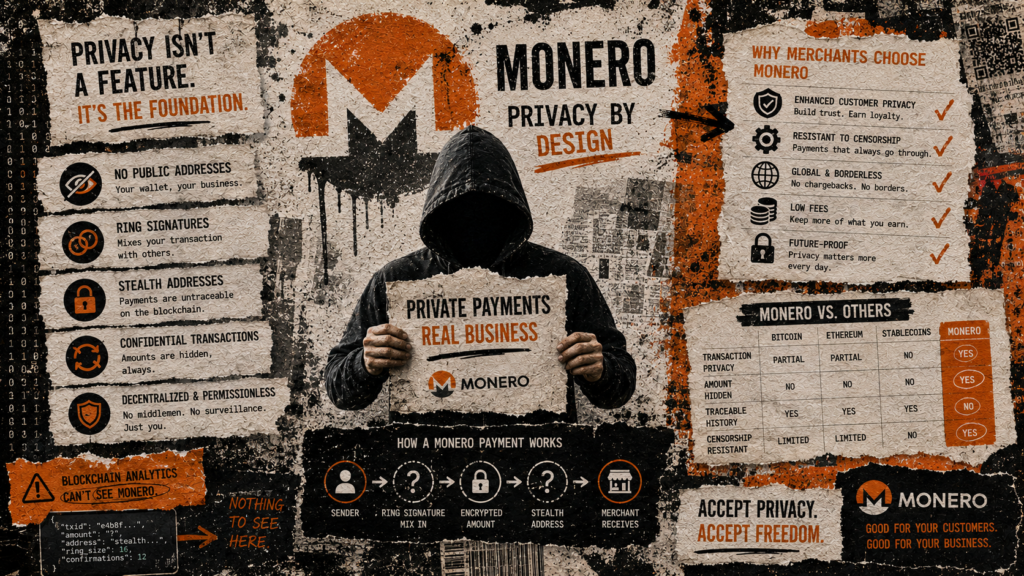
Every major cryptocurrency — Bitcoin, Ethereum, Litecoin — runs on a public ledger where anyone can look up the sender, receiver, and exact amount of any transaction. Monero (XMR) was built specifically to not work that way, and understanding why matters for any merchant deciding whether to offer it.
What makes Monero different
Monero uses a combination of ring signatures, stealth addresses, and confidential transaction amounts to obscure the sender, the recipient, and the value transferred — by default, on every transaction, with no optional privacy mode to remember to enable. On Bitcoin, anyone can paste an address into a block explorer and see its full transaction history. On Monero, that’s not possible.
Why customers specifically seek it out
- Financial privacy as a default expectation — many Monero users simply don’t think their purchase history should be publicly auditable, the same way a cash transaction leaves no public trail.
- Protection from targeted analysis — public blockchains allow anyone to link addresses to real-world identity through pattern analysis; Monero is specifically resistant to this.
- No dependency on mixing services — privacy is built into the protocol itself rather than requiring a third-party service that could introduce its own risks.
What changes for the merchant
From an operational standpoint, accepting XMR works the same as any other currency in a payment gateway — a unique address is generated per invoice, and the payment is tracked for confirmations. The privacy properties are between the customer’s wallet and the network; they don’t complicate reconciliation on the merchant side.
Confirmation times run a little longer
Monero blocks are produced roughly every two minutes, and most gateways wait for around 10 confirmations before marking a payment complete — meaning a typical wait of 10 to 20 minutes. This is a deliberate tradeoff for the network’s privacy guarantees, and worth setting expectations for upfront on the checkout page.
XMR is available as a payment option on NextWay Pay alongside BTC, LTC, ETH, SOL and USDT — enable it from your dashboard in one click.