
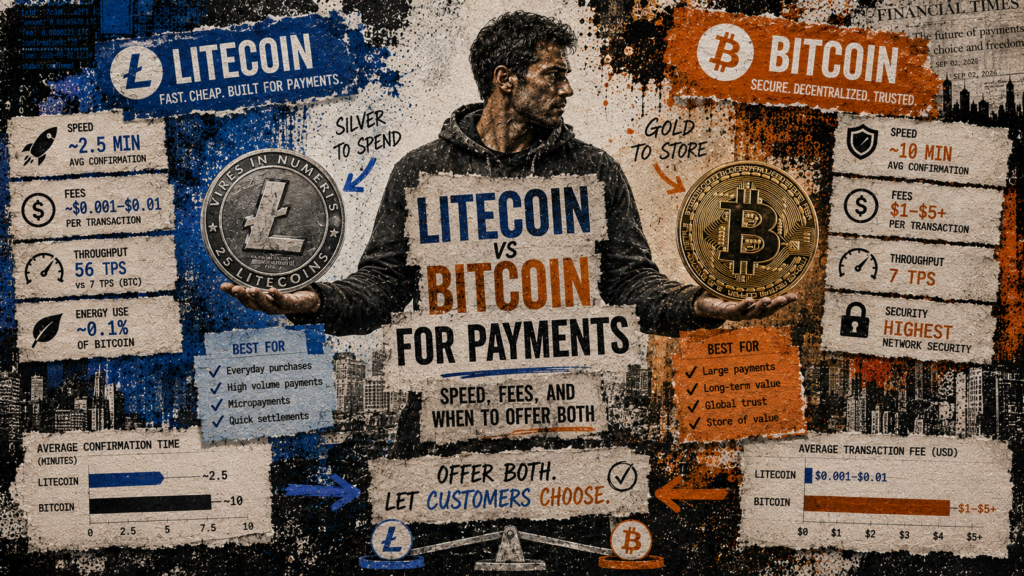
Litecoin launched in 2011 as a direct fork of Bitcoin’s codebase, with one explicit design goal: be faster and cheaper for everyday transactions while keeping Bitcoin’s core security model. Over a decade later, that positioning still holds — and it’s exactly why some merchants offer it as a companion to BTC rather than a replacement.
The core technical differences
| Bitcoin | Litecoin | |
|---|---|---|
| Average block time | ~10 minutes | ~2.5 minutes |
| Typical network fee | $1 – $5+ (varies with congestion) | Under $0.05 |
| Total supply | 21 million | 84 million |
| Primary use case | Store of value, large transfers | Fast, low-cost payments |
Why the speed difference matters at checkout
Four times faster block generation means a Litecoin payment typically reaches its first confirmation in a couple of minutes, while a Bitcoin payment during busy network periods can take considerably longer. For a customer sitting on a checkout page, that difference is the gap between “this feels instant” and “did something go wrong?”
When Bitcoin still makes more sense
Bitcoin’s larger market capitalization and network security make it the default choice for customers who already hold BTC as a long-term asset and are simply spending a portion of it. It also remains the most universally recognized cryptocurrency — customers unfamiliar with the space are more likely to already own Bitcoin than any altcoin.
Should you offer both?
Offering Litecoin alongside Bitcoin costs nothing extra in setup — it’s simply another address type generated per invoice — and it gives price-sensitive or frequency-sensitive customers (subscriptions, small recurring purchases) a cheaper, faster alternative without forcing them into a stablecoin.
Litecoin’s lower fees make it a natural fit for smaller transaction amounts, where a Bitcoin network fee could otherwise eat a meaningful percentage of the payment.
NextWay Pay supports LTC alongside BTC, USDT, ETH, SOL and XMR — enable any combination from your merchant dashboard.