
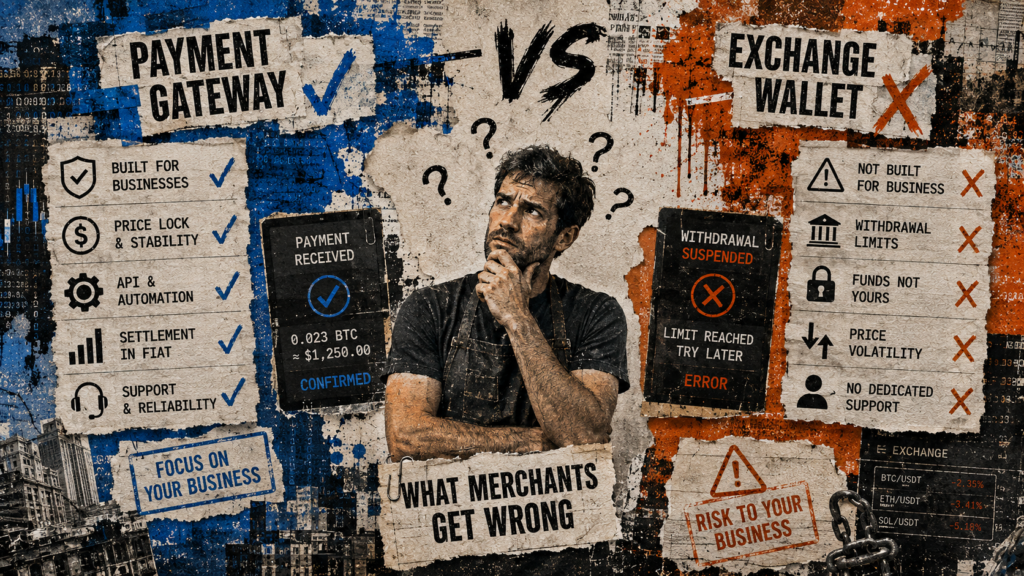
It’s tempting to skip a payment gateway entirely and just paste a personal wallet address into a website. It works — until the first refund request, the first accounting question, or the first time a customer sends the wrong amount. Here’s what a dedicated gateway actually solves.
The problem with a single shared address
If every customer pays to the same wallet address, there’s no reliable way to match an incoming payment to a specific order — especially if two customers pay the same amount around the same time. A payment gateway solves this by generating a unique address per invoice, so every incoming transaction is unambiguously tied to one order.
Refunds become possible, not improvised
Without structured records of which address received which payment for which order, processing a refund means manually digging through blockchain history. A gateway keeps that mapping automatically, so refunds and support requests can be resolved by looking up an invoice ID instead of a raw transaction hash.
Accounting and reconciliation
Tax and bookkeeping requirements don’t disappear because a payment happened on-chain. A gateway dashboard that logs every invoice with its fiat-equivalent value at time of payment turns crypto revenue into the same kind of structured record accountants already expect — instead of a wallet’s raw, unlabeled transaction history.
Volatility exposure
A personal wallet holds whatever crypto it receives, fully exposed to price swings until manually converted. Most gateways, including NextWay Pay, lock in the fiat value of an invoice for a short window at checkout, which limits the volatility risk to that window rather than however long the funds happen to sit unconverted.
What you give up by skipping a gateway
- Automatic confirmation tracking and status updates
- Webhook notifications to your store or CRM when a payment completes
- Multi-currency support without managing five different wallet apps
- A clean audit trail per transaction
NextWay Pay generates a unique address per invoice automatically, with built-in refund tracking and dashboard reporting.