
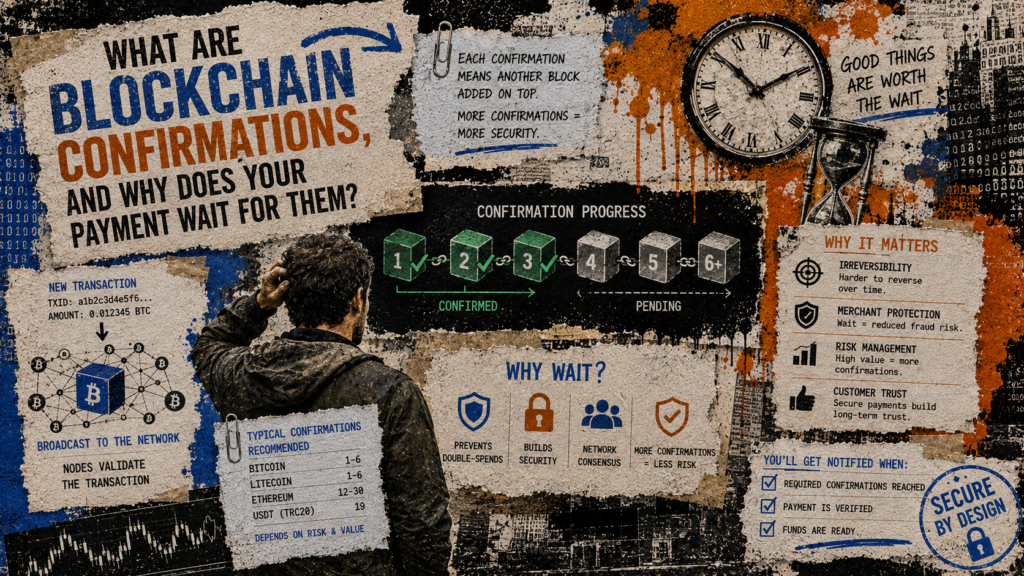
You send a payment, the wallet shows it as broadcast, and the merchant’s invoice still says “pending.” That gap between “sent” and “confirmed” confuses more customers than almost anything else in crypto checkout — and it’s worth explaining in plain terms.
What actually happens after you hit send
A crypto transaction isn’t instantly final the moment it leaves your wallet. It first gets broadcast to the network and sits in a pool of unconfirmed transactions. Miners or validators then pick it up, bundle it into a block, and add that block to the chain. Only once a transaction is included in a block does it count as one confirmation.
Why more than one confirmation is often required
A single confirmation means the transaction was included in the most recent block — but that block could theoretically be replaced if a competing block is found around the same time (a rare event called a chain reorganization). Each additional block added on top makes reversal exponentially less likely. That’s why most gateways, including NextWay Pay, wait for a small number of confirmations — typically 1 to 3 for Bitcoin — before marking a payment as fully complete.
Confirmation times by network
| Network | Average block time | Typical wait to “confirmed” |
|---|---|---|
| Bitcoin | ~10 minutes | 10–30 minutes |
| Litecoin | ~2.5 minutes | 3–8 minutes |
| Ethereum | ~12 seconds | 15 sec – 2 minutes |
| Solana | ~400 milliseconds | Under 5 seconds |
| Monero | ~2 minutes | 10–20 minutes (10 confirmations) |
What to tell customers during the wait
- The payment isn’t lost — it’s simply waiting for network validation, which is normal and expected.
- Closing the browser tab is safe. The invoice will update automatically once confirmations are received, and a receipt is typically sent by email.
- If a payment stays “pending” far longer than the network’s usual block time, it may indicate low network fee priority — this is more common on Ethereum during high congestion.
Why this matters for merchant trust
An invoice page that just says “Pending” with no context reads as broken. Showing an actual confirmation counter — “1 of 3 confirmations” — turns the same wait into visible progress, and dramatically reduces support requests asking “did my payment go through?”
Every NextWay Pay invoice shows real-time confirmation progress, so customers always know exactly where their payment stands.