
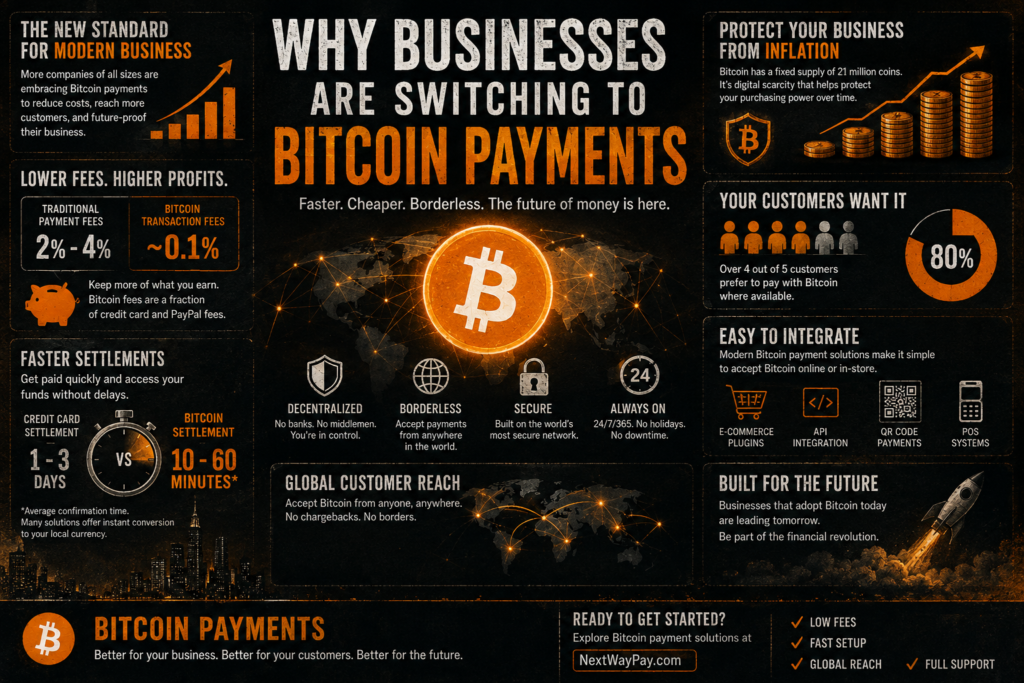
Every merchant has heard the pitch: “accept Bitcoin, save on fees.” Most stop listening right there, because it sounds like every other payment ad. But the mechanics behind that pitch are worth understanding, because they change how a business actually operates day to day — not just what shows up on the invoice.
Chargebacks disappear, not just decrease
With cards, a chargeback can happen weeks after the sale, and the merchant loses the product, the payment, and a penalty fee on top. Bitcoin transactions are final once confirmed on the blockchain. There’s no central authority that can reverse them after the fact. For digital goods and services — where the product can’t be repossessed — this single property removes one of the most common sources of fraud loss.
Fees stop scaling with revenue
Card processors charge a percentage of each transaction, which means the more successful a store becomes, the more it pays in fixed percentage fees. Bitcoin network fees are unrelated to the amount being sent — sending 5 dollars or 5,000 dollars costs roughly the same in network fees. For high-ticket items, the difference is significant.
No geographic exclusion
Traditional processors don’t serve every country equally — some regions carry higher fraud-risk ratings and get excluded entirely, or face extra scrutiny and delays. A Bitcoin address doesn’t check where the sender is located. This opens up markets that were previously unreachable simply because a card network decided the risk wasn’t worth it.
What actually changes in your checkout
- Settlement time — instead of waiting days for a card payout, on-chain payments confirm within minutes and the balance is immediately available in your dashboard.
- No merchant account approval process — there’s no underwriting review, no reserve requirement, no risk of a processor freezing your account mid-month.
- Price volatility — this is the real tradeoff. Most gateways, including NextWay Pay, lock in the fiat-equivalent amount for a short window so neither the merchant nor the customer is exposed to price swings during checkout.
Bitcoin doesn’t have to be the only option
The businesses that get the most value from crypto payments rarely offer Bitcoin alone. Pairing BTC with a fast, low-fee stablecoin like USDT covers two very different customer habits: BTC holders who want to spend directly from savings, and stablecoin users who want price stability without touching a bank.
NextWay Pay generates a unique address per invoice, tracks confirmations automatically, and settles straight to your dashboard — no merchant account required.